
Perimenopause Isn’t About Oestrogen.
It’s About Change.
Change that involves hormones, but it isn’t one change… it’s hundreds of tiny physiological adjustments happening across almost every organ system in your body, all at the same time (1).
When most people think about perimenopause, they think about hormones—particularly oestrogen (1,2). And while changing hormone levels are certainly central to the story, they’re only the beginning.
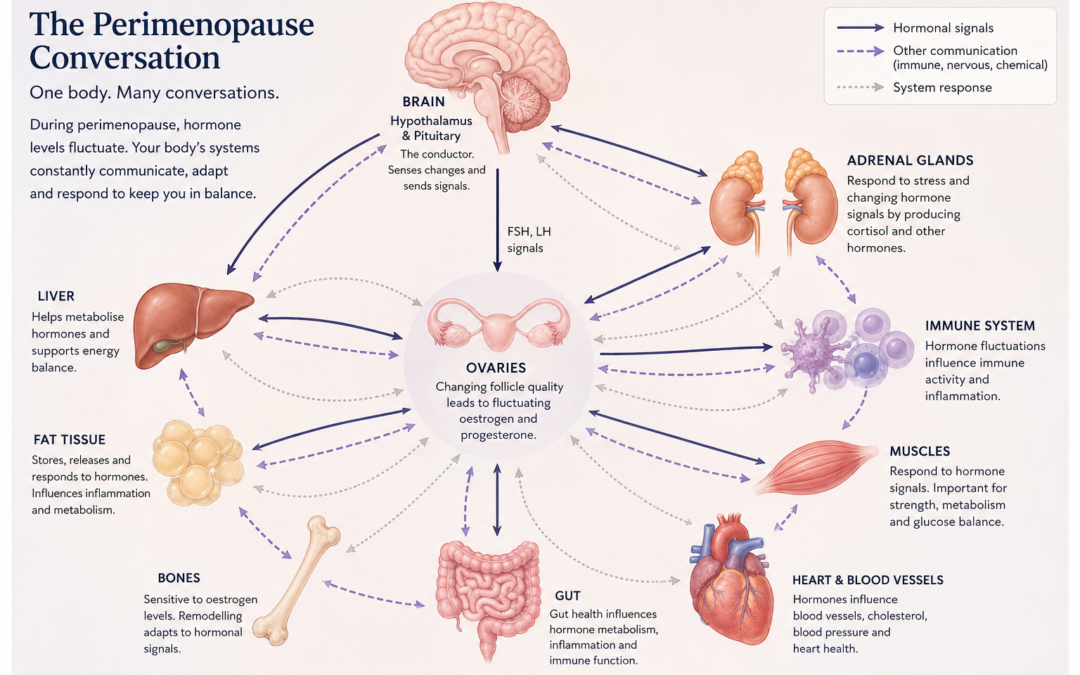
The real story is about one great hormonal conversation that is going on in your body: Your brain is talking to your ovaries. Your ovaries are talking to your adrenal glands. Your adrenal glands are talking to your immune system (1,3,4). Your muscles, fat tissue, bones, liver, heart and even your gut are all responding to those conversations while continuing to communicate with one another (1,3,5).
Perimenopause isn’t simply about one hormone becoming lower. It is your entire body learning to function within a changing hormonal environment (1,2).
In my article on The Physiology of Change, I explained that change itself is not inherently stressful. Rather, for many of us, change and stress often become closely linked—not because change is harmful, but because our brains are wired to pay attention to uncertainty (6,7). When something becomes unpredictable, unfamiliar or difficult to control, the brain may activate the body’s stress systems in an attempt to protect us (6,8).
Perimenopause is perhaps one of the greatest examples of this.
Unlike puberty, where hormone production gradually increases in a fairly predictable direction, perimenopause is characterised by fluctuation (1,2). Hormone levels don’t simply decline. They rise, fall, overshoot and sometimes behave in ways that seem almost random (1,2). One month your ovaries may produce plenty of oestrogen. The next month they may produce much less (1). Ovulation becomes less reliable and progesterone levels become increasingly inconsistent (1,2). Your brain is constantly trying to interpret these changing signals and adjust accordingly (1,9).
This is where the fascinating biology conversation begins because your body is built around communication (3).
Every second of every day, billions of cells are sending messages to one another using hormones, nerves, immune signals and chemical messengers (3,4). These conversations keep your internal environment remarkably stable despite everything happening around you. Scientists call this homeostasis—your body’s ability to maintain balance (3,8).
Perimenopause doesn’t stop these conversations, but it does change them.
The Brain: The Conductor of the Orchestra
The conversation begins in the brain. Deep within it sits a tiny region called the hypothalamus. Although only about the size of an almond, it acts rather like the conductor of an orchestra, constantly listening to every section and adjusting the performance to keep everything in harmony (3,9).
Working closely with the pituitary gland, it sends hormonal signals to the ovaries, asking them to mature follicles, ovulate and produce oestrogen and progesterone (1,3).
For many years these conversations are remarkably predictable. During perimenopause they become far less so. As the number and quality of ovarian follicles gradually declines, the ovaries no longer respond as consistently to the brain’s instructions (1,2). Sometimes they produce plenty of hormones; sometimes they don’t (1). The brain senses these changing responses and compensates by producing larger amounts of follicle-stimulating hormone (FSH) in an effort to encourage the ovaries to respond (1,2).
It’s rather like turning up the volume because the person at the other end of the phone isn’t answering as clearly as they once did.
What You Might Notice:
Because the brain sits at the centre of this conversation, changes here can ripple throughout the rest of the body (3,9). As it continually adjusts to fluctuating hormone signals, you may notice that your thermostat feels less reliable, making you suddenly feel overwhelmingly hot or unexpectedly cold (2). Sleep may become lighter or more fragmented, even if you’ve never had difficulty sleeping before (2,9). Some women describe feeling mentally “foggy,” finding it harder to concentrate, remember names or find the right word in conversation (9). Others notice they feel more emotionally sensitive, overwhelmed or anxious than usual (2,9). None of this means your brain is failing. It reflects a brain that is working incredibly hard to adapt to an ever-changing hormonal environment while continuing to regulate everything from temperature and sleep to mood, memory and stress responses (8,9).
The Ovaries: Changing the Conversation
The ovaries are often described as if they simply “run out of oestrogen.” The reality is much more interesting. They continue trying to produce hormones, but they do so less predictably because fewer follicles remain capable of responding each month (1,2). One cycle may produce high oestrogen levels; the next may produce much lower levels (1). Some cycles still release an egg; others don’t (1,2).
Without ovulation, progesterone production falls dramatically, meaning that oestrogen and progesterone are no longer working in their usual partnership (1,2).
It is often this unpredictability—not simply low hormone levels—that drives many of the early physiological changes of perimenopause (1,2,9).
What You Might Notice:
As the ovaries become less predictable in their hormone production, you may begin to notice that your menstrual cycle no longer follows the reliable pattern you’ve known for decades (1,2). Some months everything feels completely normal, while other months seem entirely different. You may find that symptoms such as breast tenderness, bloating, headaches or premenstrual mood changes become more noticeable one month and almost disappear the next (1,2). This unpredictability can be one of the most frustrating aspects of perimenopause, but it reflects changing hormone patterns rather than your body “getting it wrong.”
The Adrenal Glands: Providing Support
Although the ovaries remain the principal producers of oestrogen before menopause, the adrenal glands quietly contribute another important piece of the puzzle (3).
They produce DHEA (dehydroepiandrosterone), a hormone that can be converted into testosterone and oestrogens in other tissues when needed (3,5).
The adrenal glands are also responsible for producing cortisol—the body’s main stress hormone (3,8).
This means that the body’s response to emotional stress, poor sleep, illness or overwork is occurring at exactly the same time that reproductive hormones are becoming less predictable (3,8,9).
For some women, this may amplify symptoms—not because stress causes perimenopause, but because both systems influence one another (3,8,9).
What You Might Notice:
When the adrenal glands are helping your body respond to everyday stresses while your reproductive hormones are also fluctuating, life can sometimes feel less forgiving than it used to (3,8). You may notice that poor sleep affects you more deeply, that stressful days take longer to recover from or that your usual coping strategies don’t seem quite as effective (8,9). Small challenges may feel disproportionately exhausting, not because you’ve become less resilient, but because two important hormonal systems are adapting at the same time (3,8). Looking after your stress levels therefore becomes even more important—not because stress causes perimenopause, but because reducing unnecessary stress gives your body more capacity to adapt well (6,8).
Fat Tissue: Much More Than Energy Storage
Fat tissue was once thought of simply as somewhere we stored excess energy. We now know it behaves much more like an endocrine organ (5). Fat cells produce hormones and inflammatory signalling molecules and contain an enzyme called aromatase, which converts some androgens into oestrogens (5).
As ovarian hormone production changes, fat tissue becomes an increasingly important contributor to the body’s hormonal environment (5).
At the same time, changing hormone levels influence where fat is stored, often shifting it from the hips and thighs towards the abdomen (5). This isn’t simply about appearance; it reflects changing metabolism throughout the body (5).
What You Might Notice:
Many women become frustrated when they find that their bodies seem to change despite eating and exercising much as they always have (5). Clothes may fit differently, particularly around the waist, even if the number on the scales changes very little (5). Some women notice that losing weight becomes more difficult or that they seem to gain abdominal fat more easily (5). These changes are not simply about willpower or ageing; they reflect the body’s changing hormonal and metabolic environment (5). Understanding this can replace self-blame with a more compassionate and realistic approach to caring for your health.
Muscles: The Body’s Metabolic Engine
Muscle does far more than move us. It stores glucose, improves insulin sensitivity, produces anti-inflammatory signalling molecules called myokines, supports bone, protects joints and even influences brain health (10). Changing oestrogen levels affect how efficiently muscles repair themselves after exercise, respond to protein and maintain strength (10).
This helps explain why strength training becomes increasingly important during midlife—not because women are becoming weaker, but because the physiology supporting muscle maintenance is changing (10).
What You Might Notice:
You may notice that everyday tasks feel just a little more demanding than they once did (10). Carrying heavy shopping, lifting grandchildren, climbing stairs or recovering after a challenging workout may take a little longer (10). You might also feel that your strength isn’t improving quite as quickly as it used to, even when you’re exercising regularly (10). This doesn’t mean exercise is becoming less effective. In fact, the opposite is true. It means that maintaining and building muscle becomes increasingly valuable because your body now relies more heavily on regular strength training to preserve muscle mass, support metabolism, protect your bones and maintain long-term independence (10).
The Immune System: Constantly Adapting
The immune system is also part of this conversation: oestrogen helps regulate immune activity and inflammation (4). As hormone patterns fluctuate, inflammatory signalling may temporarily become less well regulated, contributing to symptoms such as joint aches, stiffness and changes in energy levels for some women (4,10).
Again, these aren’t isolated symptoms; they’re reflections of a body adapting to a new hormonal landscape (1,4).
What You Might Notice:
As the immune system adapts to changing hormone patterns, some women notice that they feel a little stiffer when they wake up, that their joints ache more than they used to or that they simply don’t bounce back from illness or periods of stress quite as quickly (4,10). Others notice fluctuations in energy levels that seem difficult to explain (8,9). These experiences can feel unrelated, but they may all reflect subtle shifts in inflammatory regulation occurring throughout the body as it adjusts to a new hormonal landscape (4).
Finally… The Menstrual Cycle
Perhaps the most obvious sign that these conversations are changing is the menstrual cycle itself (1,2).
As ovulation becomes less predictable, progesterone production also becomes less predictable (1,2). Without the balancing influence of progesterone, the lining of the womb may continue to thicken under the influence of oestrogen for longer than usual before finally shedding (1,2).
This is one reason periods can become heavier, but there are several: Sometimes several follicles begin developing but none ovulate (1). Sometimes ovulation occurs much later than expected (1,2). Sometimes hormone levels fall suddenly, causing an early bleed (1). At other times, the womb lining has built up over several months before finally being shed (1,2).
The result can be periods that seem completely out of character—closer together, further apart, lighter, heavier or simply unpredictable (1,2).
Although this can be frustrating, it reflects the changing conversations between the brain, ovaries and uterus rather than the body “malfunctioning” (1,2).
What You Might Notice:
For many women, the menstrual cycle provides the first obvious clue that this great hormonal conversation is changing (1,2). Periods that once arrived with reassuring regularity may become less predictable (1,2). They may come closer together, further apart, last longer or finish more quickly than before (1). Some become unexpectedly heavy, with flooding or larger clots, while others become surprisingly light (1). You may occasionally skip a period altogether, only for the next one to arrive seemingly out of nowhere (1,2). Although these changes can be unsettling, they are usually a reflection of the increasingly unpredictable communication between the brain, ovaries and uterus (1,2). Rather than following the familiar rhythm your body has maintained for decades, the hormonal conversation has become more variable—and your periods are simply one visible expression of that change (1).
A Body That Is Adapting, Not Failing
When you understand the physiology of perimenopause, something remarkable happens. The symptoms stop feeling random – instead, they begin to make sense (1,2). Hot flushes, changing sleep, brain fog, altered body composition, changing periods and
emotional ups and downs are not isolated problems occurring independently (1,2,5,9). They are different expressions of the same whole-body adaptation (1,3).
That doesn’t mean every symptom can—or should—be ignored. Some symptoms deserve medical assessment and there are many effective treatments available when needed (2). But understanding what your body is trying to do can replace fear with curiosity and anxiety with confidence (6,7).
Your body isn’t falling apart; it’s recalibrating (1,3).
And just as we explored in The Physiology of Recovery, the remarkable thing is that every aspect of your health can help support that recalibration (3,8). Nutritious food provides the building blocks for repair (5). Strength training helps preserve muscle and bone (10). Cardiovascular exercise supports heart and brain health (8,10). Good sleep allows restoration (8,9). Looking after your emotional wellbeing helps regulate your stress systems (6,8). Meaningful relationships, movement, time in nature and moments of rest all become part of the conversation too (6,8,11).
Perimenopause is a time of profound biological change, but it is also a time of extraordinary adaptation (1,3). Understanding what is changing and why may help to prevent your body’s stress systems from thinking it needs to protect you from the perceived threat of these changes (6,7). By regulating your nervous system if you no longer fear the conversation your body is having, you can begin to work with it (6,8,11).
References
1. Talaulikar VS. Menopause transition: Physiology and symptoms. Best Pract Res Clin Obstet Gynaecol. 2022;81:3-14.
2. Santoro N, Roeca C, Peters BA, Neal-Perry G. The Menopause Transition: Signs, Symptoms, and Management Options. J Clin Endocrinol Metab. 2021;106(1):1-15.
3. Herman JP, Maroun M, Richter-Levin G. Regulation of the Hypothalamic-Pituitary-Adrenocortical System: Stress and Resilience. Neurobiol Stress. 2020;12:100216.
4. Abildgaard J, Tingstedt JL, Pedersen BK, Lindegaard B. Low-grade inflammation in perimenopause and postmenopause: relations to adipose tissue and oestrogen. Maturitas. 2021;145:26-33.
5. El Khoudary SR, Aggarwal B, Beckie TM, Hodis HN, Johnson AE, Langer RD, et al. Menopause Transition and Cardiovascular Disease Risk: Implications for Health Assessment and Strategy: A Scientific Statement From the American Heart Association. Circulation. 2020;142(25):e506-e532.
6. Biggs A, Brough P, Drummond S. Lazarus and Folkman’s Psychological Stress and Coping Theory. In: Cooper CL, Quick JC, editors. The Handbook of Stress and Health. Chichester: Wiley Blackwell; 2017. p. 351-364.
7. Peters A, McEwen BS, Friston K. Uncertainty and stress: Why it causes diseases and how it is handled by the brain. Prog Neurobiol. 2017;156:164-188.
8. McEwen BS, Akil H. Revisiting the Stress Concept: Implications for PTSD and Chronic Stress Physiology. Front Neuroendocrinol. 2020;56:100811.
9. Maki PM, Jaff NG. Brain fog in menopause: Defining the problem and finding solutions. Menopause. 2022;29(11):1223-1227.
10. Wright VJ, Schwartzman J, Itinoche M, Wittstein J. Musculoskeletal syndrome of menopause. Climacteric. 2024;27(1):42-49.
11. Porges SW. Polyvagal Theory: A Biobehavioral Model of Insight, Self-Regulation, and Vulnerability. Schizophr Bull. 2023;49(Suppl 1):S12-S20.